Know everything to crochet well in joined rounds
Why crochet in joined rounds?
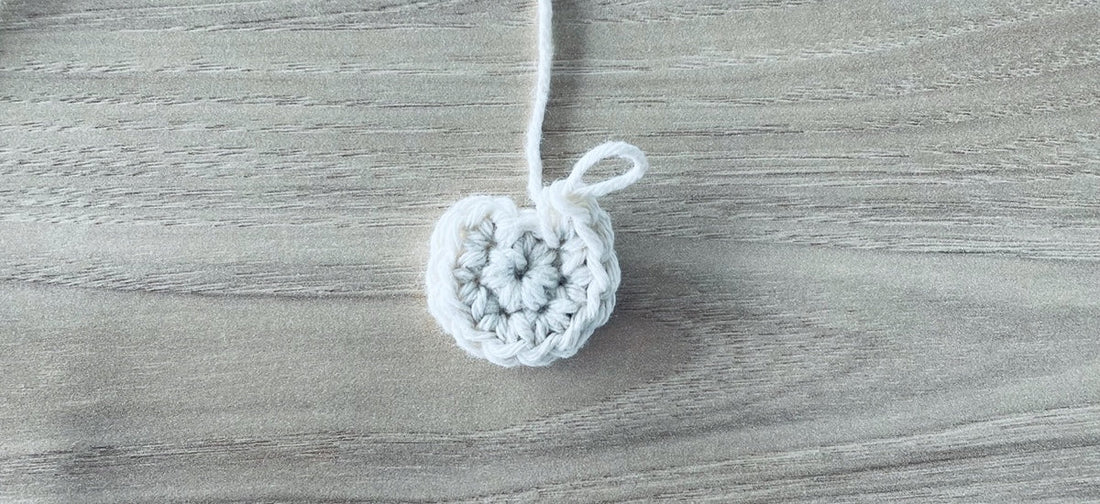
Why crochet in joined rounds? Crocheting in closed rounds is a different technique from spiral crochet. This technique allows you to crochet in rounds but we close the round at each row to form a circle. Row circles are concentric unlike spiral rows. I will explain the technique in detail later.
We use this technique when we want to avoid the shift of stitches that we have between each row when we crochet in spiral. This is very useful when crocheting double crochet in rounds. Closed rounds technique is also used when crocheting flowers.
Crochet in joined rounds, it's easy!
Crochet in joined rounds is super easy! It is often a preconceived idea to think the opposite. Personally I even find this technique simpler than crocheting in a spiral. The stitch marker is not mandatory because the beginning and the end of the row are quite distinct.
The secret to good stitch counting
There is a secret to not being wrong 😉 I'll explain it to you. The principle is simple: after the last stitch of the row that we are finishing, we make a slip stitch (sl st.) in the first stitch of the row. It is this slip stitch that closes your round. This slip stitch doesn't count in the total stitches count of the row. It is a technical stitch to make a connection. It is repeated at each row but it is never counted. I call them the “useless” stitches.
Once the circle is closed, we must "pull up" our yarn to the height of the stitches we want to make. We make the yarn goes up by making chain stitches (ch.). If we do not pull up our yarn, then the first stitch of our row will be twisted and crushed which will give a strange appearance to the work. As for the slip stitch which closes the row, these ch. st. doesn't count in the total stitches count of the row.

The Rule of joined round
Here is the rule to join a round before starting a new one :
- For a single crochet row: 1 sl. st., ch. 1 (or 2 "useless" stitches)
- For a half double crochet row: 1 sl. st., ch. 2 (or 3 "useless" stitches)
- For a double crochet row: 1 sl. st., ch. 3 (or 4 "useless" stitches)
- For a treble crochet row: 1 sl. st., ch. 4 (or 5 "useless" stitches)
Examples
I crochet in joined rounds a round of 12 single crochet stitches. On this row, I have 12 single crochet, 1 slip stitch and 1 chain. If I count all the stitches' loops, I count 14 stitches. This is correct because I have 12 stitches and 2 "useless" stitches which close each row to form concentric circles.
I crochet in joined rounds a round of 18 double crochet stitches. On this row, I have 18 double crochet, 1 slip stitch and 3 chain. If I count all the stitches' loops, I count 22 stitches. This is correct because I have 18 stitches and 4 "useless" stitches.

Where to prick the crochet hook to join the round?
Since the beginning of this article, I write about counting the stitches but I didn't tell you where to prick the crochet hook to make the slip stitch that closes the round! Well, we make that slip stitch in the first stitch of the row, that's the secret 😉 We skip the “useless” stitches and continue in the first stitch of our row to start the next round.
This first stitch... we do a lot of things to it when we work in joined rounds. In this stitch we make:
- The slip stitch that closes the row. The tighter we make it, the less we will see it.
- The number of chain stitches needed to pull up the yarn (see the rule explained above).
- The stitches that our pattern asks us to make in the first stitch. Single crochet, increase, decrease, back loop, front loop whatever, we work the first stitch as indicated by our pattern in the stitch where we made the slip stitch. This is very important.

Crocheting in joined rounds now has no secrets for you! Good crochet ;)
6 comments
Merci , j’ai enfin compris pourquoi j’avais des mailles supplémentaires sur mes Amigurumi 🙏☺️
Bonjour Mélanie,
Merci pour votre commentaire ! Je suis ravie que mon article continue d’être utile, même quelques mois après sa publication.
Pour répondre à votre question concernant l’emplacement de votre première maille serrée après avoir fait une maille en l’air pour débuter un nouveau rang, je vous invite à relire attentivement la section de l’article intitulée “Où piquer son crochet pour fermer son rang ?”. Vous y trouverez une liste détaillée de toutes les actions à effectuer sur la première maille du rang. Cette section explique notamment où faire la maille coulée pour fermer le rang, les mailles en l’air pour monter à la hauteur du rang suivant, et l’emplacement de la première maille de ce nouveau rang, selon les indications de votre patron.
J’espère que cela vous aidera !
Meilleures salutations,
Fanny Le Merdy
Waouh, j’ai l’impression d’avoir compris… je planche depuis quelques jours sur un « chapeau « et je ne m’en sors pas avec le nombre de mailles! Je défais tout et vais recommencer en suivant vos conseils, j’espère m’en sortir mieux…😉
Bonjour
Je ne sais pas si j’aurai une réponse car votre article date de quelques mois mais on verra bien…
Quand j’ai fermé mon rang et que j’ai fait une maille en l’air pour attaquer le nouveau rang, est-ce que je fais ma maille serrée dans la même maille que la maille en l’air ou dans la suivante?
Merci d’avance
Mélanie
Merci beaucoup ! J ai ENFIN compris les rangs fermés… et pourtant j en ai regardé des vidéos !! Vos explications et vos schémas sont très clairs. 👏